Loading...
Loading...
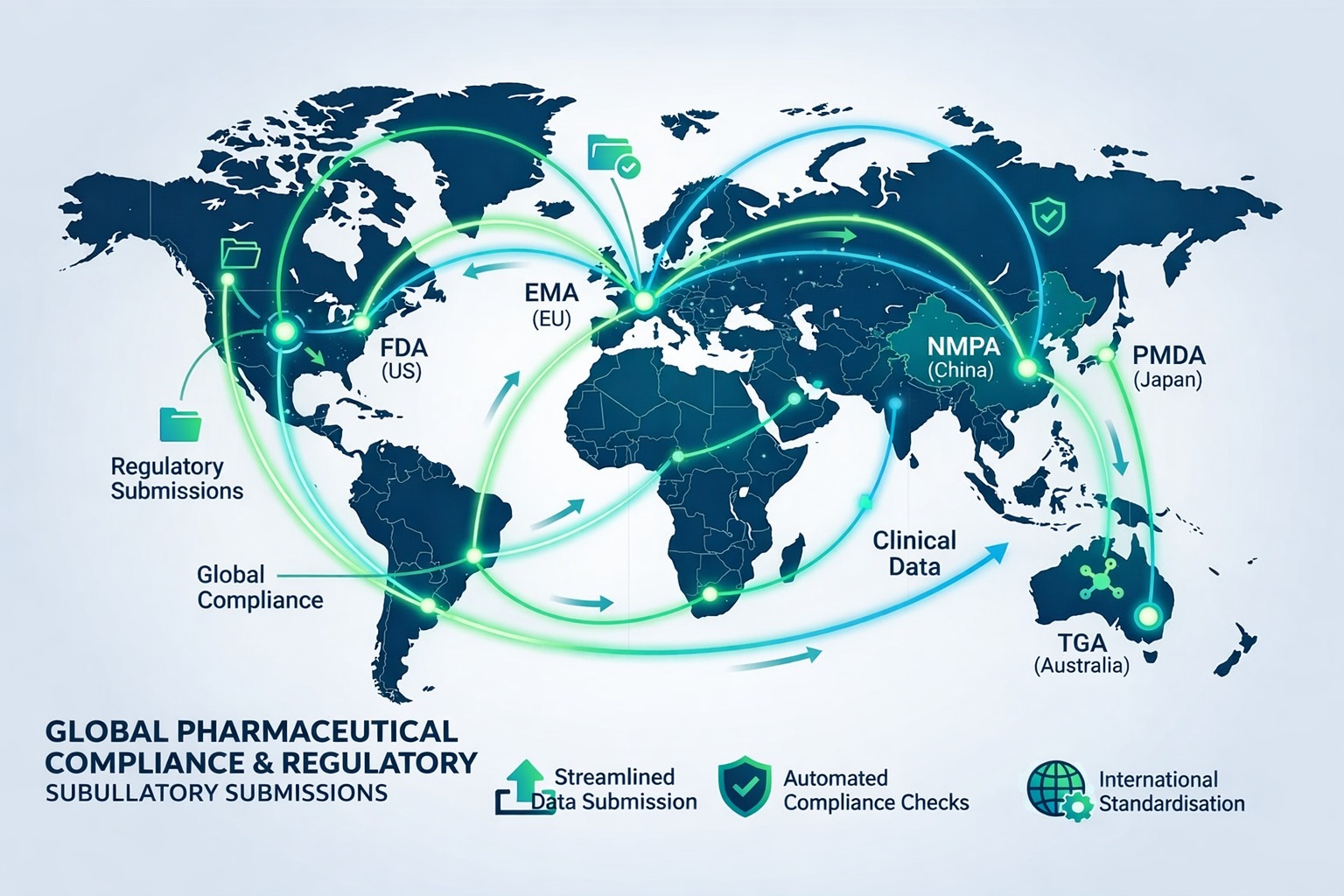
Pharmaceutical companies operate in one of the most highly regulated industries in the world. Each new drug, medical device, or biologic must pass through multiple layers of review and approval before reaching patients. What makes this process even more challenging is that regulatory requirements differ significantly across regions.
From the U.S. FDA to the European Medicines Agency (EMA), Health Canada, and other regional authorities, every agency has unique submission formats, document structures, and validation criteria.
For global organizations, managing multi-region regulatory submissions involves not just compiling vast documentation but ensuring that every version meets each authority's expectations — accurately, on time, and without duplication.
In short, global submissions are no longer about completing forms; they're about coordinating complex data across multiple regulatory ecosystems.
Each global health authority has its own set of standards for document format, sequence structure, and submission lifecycle management. Understanding these variations is crucial to avoid delays or rejections.
Here's a quick overview of key regional differences:
| Region | Authority | Format/Guideline | Unique Challenges |
|---|---|---|---|
| USA | FDA | eCTD (Module 1 – US specific) | Strict validation rules; electronic gateway submission via ESG |
| EU | EMA | eCTD (EU Module 1) | Multiple languages; centralized and decentralized procedures |
| Canada | Health Canada | eCTD (HC Module 1) | Separate validation and structure requirements |
| UK | MHRA | eCTD (UK Module 1) | Independent procedures post-Brexit |
| Japan | PMDA | NeeS/eCTD | Localized content and translations |
| Australia | TGA | eCTD/NeeS | Hybrid acceptance during transition to full eCTD |
| South Africa & GCC | SAHPRA / SFDA | NeeS or regional variations | Evolving standards and limited automation tools |
This fragmentation means that even a single global submission (e.g., for a new drug application) must be tailored and revalidated for each market. Without a robust system, managing this complexity manually is both time-consuming and error-prone.
To manage these regional differences effectively, companies are adopting Regulatory Submission Content Management (RSCM) systems — platforms that streamline document preparation, review, version control, and publishing. An RSCM platform serves as a single source of truth for all submission documents, data, and metadata. It allows regulatory teams to:
This shift toward content-centric submission management is helping life sciences organizations eliminate duplication and accelerate their submission cycles across global regions.
A key principle in global submission management is modularity — the ability to reuse common dossier sections (like Modules 2–5 in the eCTD) while customizing only region-specific sections (Module 1).
By designing regional templates, pharma companies can structure submissions more efficiently:
This modular approach saves significant time and ensures consistency across submissions while maintaining flexibility for local adjustments.
For instance, if a company updates a formulation in its quality section, that same update can automatically propagate to all related dossiers across regions — ensuring accuracy and alignment.
Each regulatory authority runs its own validation checks before accepting submissions. These automated checks verify structure, metadata, file formats, and hyperlinks. A single formatting or naming error can lead to a rejection. Some common examples:
Automated validation tools built into modern RIM (Regulatory Information Management) or publishing software help detect such issues early — ensuring submissions pass authority checks without delays.
To manage multi-region regulatory activities efficiently, life sciences companies are increasingly relying on specialized software platforms designed for global submission management.
Key capabilities of these tools include:
Automated publishing tools assemble submissions in eCTD or NeeS format, validate structure and metadata, and generate authority-specific envelopes for FDA, EMA, and other agencies.
RIM systems centralize submission planning, product registration tracking, and license lifecycle management across multiple regions. They ensure that each product's regulatory history is traceable and up to date.
Cloud-based solutions enable distributed teams — from HQ to affiliates — to collaborate on documents in real time, reducing duplication and improving version control.
AI-driven tagging tools help auto-populate submission metadata, ensuring consistency across regions and reducing manual workload.
Comprehensive submission archives allow teams to retrieve any document version instantly for audits, inspections, or future updates.
At Educe Solutions, our suite of regulatory software tools — including DocsExecutive™, Regulatory Submission Manager, and eCTD Validator — empowers pharmaceutical companies to streamline multi-region submissions with confidence. Our systems are designed for compliance, efficiency, and scalability, enabling you to manage global dossiers seamlessly.
To ensure success in global regulatory submissions, pharma companies should adopt the following best practices:
Managing global regulatory submissions no longer needs to be a fragmented, error-prone process. With the right combination of RIM systems, eCTD publishing tools, and centralized content management, pharma companies can achieve true multi-region compliance — efficiently and consistently.
Automation enables teams to focus on what matters most: speeding safe, effective products to global markets while maintaining full compliance with local regulations.
At Educe Solutions, we help life sciences organizations streamline every step of the submission lifecycle — from authoring and validation to publishing and archival. Our technology simplifies complexity so your regulatory teams can work smarter, not harder.