
Loading...
Loading...
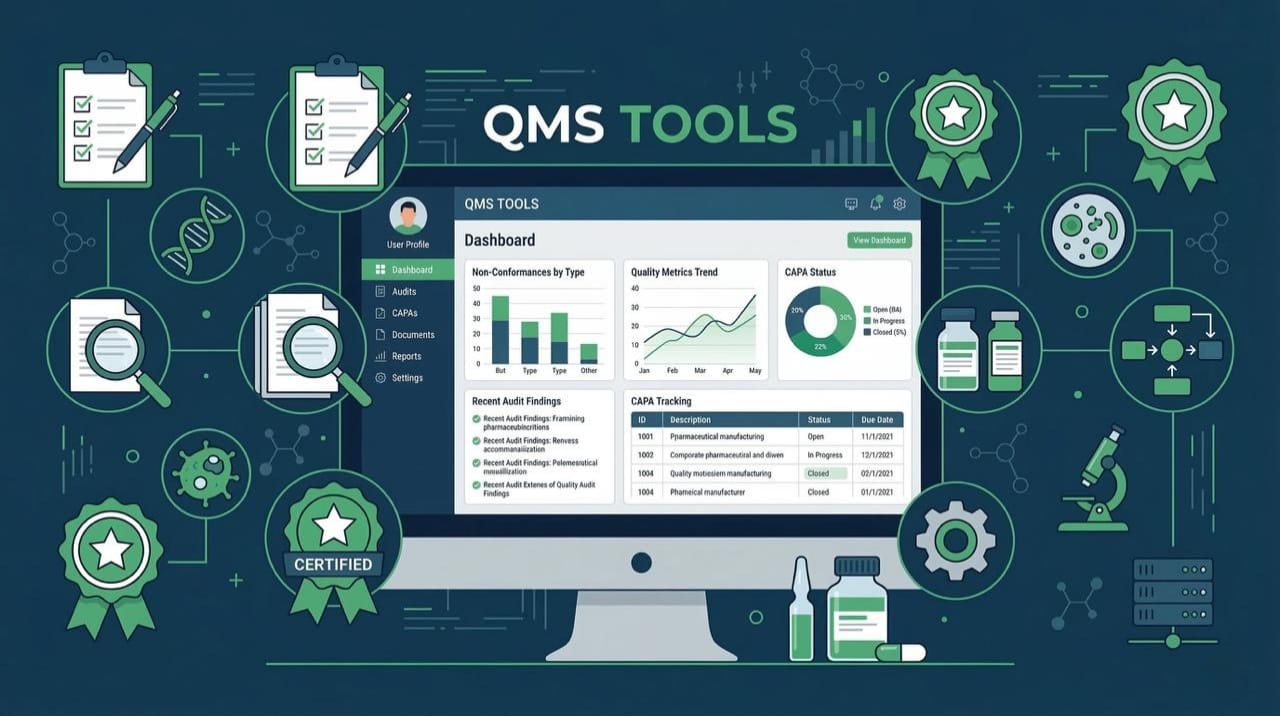
In the pharmaceutical world, quality is non-negotiable. Every tablet, vial, or vaccine must meet stringent regulatory standards to ensure patient safety and product efficacy. That's why every pharma company, from R&D to manufacturing, relies on a strong Quality Management System (QMS).
A QMS is more than just a compliance tool — it's the backbone of Good Manufacturing Practices (GMP) and regulatory integrity. It standardizes processes, manages documentation, tracks training, and ensures every deviation, change, or corrective action is properly recorded and resolved.
Regulatory authorities like the FDA, EMA, and WHO require companies to demonstrate a functioning QMS during inspections. Inadequate documentation, missed CAPAs, or incomplete training records can result in warnings, delays, or product recalls. Hence, a robust QMS isn't just a best practice — it's a business necessity.
A comprehensive Quality Management System in pharma integrates multiple modules to ensure end-to-end control and visibility. The most critical components include:
CAPA is at the heart of continuous improvement. It ensures that when deviations or complaints arise, they are analyzed, root causes identified, and long-term preventive actions implemented. Automated CAPA systems streamline the process by assigning tasks, sending reminders, and ensuring accountability.
Deviations occur when processes or results don't meet predefined standards. A digital deviation management system helps log, categorize, investigate, and resolve deviations efficiently while maintaining full traceability.
Every change in a regulated environment — from a manufacturing process tweak to a document revision — must be assessed for risk and approved systematically. A change control module ensures structured evaluation, impact assessment, and documentation of every modification.
Managing SOPs, policies, batch records, and regulatory documents requires a secure, version-controlled repository with e-signature capabilities and 21 CFR Part 11 compliance.
Employees must be trained on SOPs and quality standards. A digital e-Training module tracks training assignments, completion rates, and certifications — ensuring only qualified personnel perform regulated tasks.
Together, these modules create a connected quality ecosystem that drives consistency, accountability, and compliance.
Many pharmaceutical companies still rely on paper-based or spreadsheet-driven QMS workflows. While this might work temporarily, it introduces significant risks:
These inefficiencies slow down compliance activities and create a reactive rather than proactive quality culture. In a world where digital transformation is accelerating, manual QMS models are simply not sustainable.
An automated QMS software transforms how quality is managed, monitored, and measured across the organization. Here's how automation adds value:
Automation eliminates manual steps by routing tasks, sending alerts, and ensuring reviews and approvals happen on time. For instance, a CAPA triggered by a deviation can automatically notify relevant stakeholders for investigation and closure.
With centralized dashboards, quality teams can track open deviations, overdue CAPAs, or pending trainings — all in one view. This real-time visibility drives faster decisions and continuous improvement.
Digital records ensure every action — whether document approval, training completion, or CAPA update — is time stamped and audit-traceable. This supports full compliance with regulatory expectations for data integrity.
Automated systems prevent oversights, missed deadlines, or inconsistent documentation. Built-in validation rules ensure that all steps comply with defined SOPs.
During audits, automation simplifies evidence retrieval. Reports, records, and electronic signatures can be accessed instantly — reducing preparation time and stress.
At Educe Solutions, we understand that every pharmaceutical organization has unique quality challenges. That's why we've developed a modular, flexible QMS platform designed to meet the needs of regulated life sciences companies.
Our QMS suite includes:
Each module integrates seamlessly to provide an end-to-end quality ecosystem that ensures compliance, transparency, and accountability. Modules can also be integrated with SAP based on the requirements of the customer.
Transitioning from a manual to an automated QMS can be smooth if planned strategically. Here's how to ensure success:
With the right approach, an automated QMS can deliver rapid ROI and elevate your organization's compliance maturity.
As the industry embraces Industry 4.0, the next evolution of QMS will be AI-driven and predictive. Future-ready systems will analyze patterns in deviations and CAPAs to predict potential quality risks before they occur.
Integration with manufacturing execution systems (MES) and regulatory databases will enable a truly connected compliance ecosystem — where quality is embedded in every process, not just monitored at the end.
Automation isn't just about compliance anymore — it's about empowering pharma companies to deliver safer products, faster, with greater confidence.
Quality excellence is the foundation of trust in pharmaceuticals. By embracing automation, pharma companies can shift from reactive compliance to proactive quality management.
At Educe Solutions, our mission is to help life sciences organizations build intelligent, audit-ready, and globally compliant QMS platforms. Whether you need CAPA management, document control, or full QMS automation, our solutions bring clarity, consistency, and confidence to your quality operations.